Showing posts with label Bothriechis schlegelii. Show all posts

Wednesday, March 27, 2019

Tenorio Volcano NP - Rio Celeste

Volcano Tenorio National Park is located in the north of Costa Rica. The 11,900 ha of the park include rain forest and primary cloud forest. Many different species of animals live in this park, for example the rarely seen Tapir. The main reason for a visit is the beautiful river Rio Celeste and its waterfall. What makes Rio Celeste so unique is the name-giving color: Bright turquoise-blue!

Typical "I was here" pic, next to the NP sign.
The trails can be muddy, slippery and steep... so I would recommend hiking shoes or boots (at the entrance they have boots for rent). Meanwhile, the Tenorio National Park is quite popular, so if you don't want to hang around with many tourists, you should arrive early in the morning. Especially at the waterfall, it gets quite crowded later in the day and there might be "selfie-jams". Swimming is forbidden, which protects nature and is beneficial for landscape photography.

Stairway to the waterfall
Rio Celeste - Waterfall
Surrounded by this amazing landscape, it can be hard to focus on the search for reptiles. It was funny to see almost all the other visitors walking past this small venomous snake, without seeing it. I showed the snake to people who politely asked me what I was photographing.  Also I gave them some quick information about this interesting animal.

Bothriechis schlegelii - Eyelash Viper
Eyelash Viper (Bothriechis schlegelii)
It was way easier to spot the curious White-nosed Coati. Feeding wild animals is prohibited in the national park. Some people still do it anyway, so the Coatis often come close to humans, begging for food.
Nasua narica - White-nosed Coati
White-nosed Coati (Nasua narica)
Rio Celeste
Spilotes pullatus - Tiger Rat Snake
Do you see this gorgeous creature?
My favorite observation of the day was this -at least 2 meter long- Tiger Rat Snake (Spilotes pullatus). It was climbing elegantly in the trees at a height of about 4 meters. This snake is non venomous and diurnal.

Spilotes pullatus - Tiger Rat Snake
Tiger Rat Snake (Spilotes pullatus)
Rio Celeste
Rio Celeste
The landscape with its fantastic river is a very good reason to visit the park. There is also the possibility to observe some animals. I was very happy about the sightings of the snakes! But I can reassure those who want to enjoy the landscape without seeing any snakes: if you don't look for them, it is very unlikely to see any. Of course they are around - that's the jungle.

Monday, March 4, 2019

Variable Viper

I already mentioned it in my post about the Camouflage Viper: Eyelash Vipers (Bothriechis schlegelii) are extremely variable in coloration. Here I want to share some examples of color morphs with you.

Bothriechis schlegelii - Eyelash Viper

This pale green coloration seems to be quite common. I have seen this juvenile Viper near La Fortuna.

Bothriechis schlegelii - Eyelash Viper "oropel"

When I am searching for gold in the rainforest, I am not talking about precious metals. In spanish this yellow color morph is called "oropel" (tinsel / gold).

Bothriechis schlegelii - Eyelash Viper

This light-brown to salmon colored Eyelash Viper was coiled up on a leaf of a Panama Hat Plant (Carludovica palmata), next to the trail in Cahuita National Park.

Bothriechis schlegelii - Eyelash Viper

I have never seen another viper in this extremely bright color. The camouflage is actually very good, because the snake looked pretty much like the lichens on the branches.

Bothriechis schlegelii - Eyelash Viper "christmas tree"

I conclude with my favorite: The "christmas tree" color morph. Such a stunning snake!

Friday, January 11, 2019

Camouflage Viper

My first snake photo of 2019: Eyelash Viper (Bothriechis schlegelii)
This species is known for its many different color variants. The most famous color morph is probably the yellow one. Here I had the pleasure to discover this well camouflaged beauty. The local people call this snake "Bocaracá". 

Bothriechis schlegelii - Eyelash Viper


Friday, February 16, 2018

New nocturnal neighbors

Since January I am working (volunteering) for Callidryas Tours and Arenal Oasis as a tour guide. At the Arenal Oasis Eco Lodge I saw numerous animals, especially during the night hikes. Here I want to share some of those with you.

Powdered Glass Frog - Teratohyla pulverata

This cute Powdered Glass Frog (Teratohyla pulverata) messures barely a length of 3 cm (1.2 in) max. Due to their small size and good camouflage, they are hard to find.

Blunthead Tree Snake - Imantodes cenchoa

I found this juvenile Blunthead Tree Snake (Imantodes cenchoa) coiled up on the leaf of a bromelia. These snakes feed mainly on frogs and lizards.

Cricket

Shiny green Rhinoceros Katydid (Copiphora cultricornis) nymph.

Pygmy Rain Frog - Pristimantis ridens

The Pygmy Rain Frog (Pristimantis ridens) is very common in this area. Growing to 2.5 cm (0.98 in), this is another very small species.

Striated Webfoot Salamander - Bolitoglossa striatula

Quite rare to see: Striated Webfoot Salamander (Bolitoglossa striatula). This species occurs in Honduras, Nicaragua and Costa Rica. 

Bullet Ant - Paraponera clavata

This big ant is 3 cm (1.2 in) long and feared by man. The sting of this species is considered to be the most painful sting of the entire insect kingdom. It's described to be as painful as a gunshot. That's why this ant is called Bullet Ant (Paraponera clavata).

Red-eyed Treefrog - Agalychnis callidryas

The Red-eyed Treefrog (Agalychnis callidryas) should be part of every night hike in Costa Rica...

Eyelash Viper - Bothriechis schlegelii

Beautiful coloration on this juvenile Eyelash Viper (Bothriechis schlegelii). They are ambush predators, so they can remain motionless for hours.

Emerald Glass Frog - Espadarana prosoblepon

And thus the circle closes, I finish this report as I started it: with a member of the amphibian family called Centrolenidae. This one is an Emerald Glass Frog (Espadarana prosoblepon).


Saturday, December 23, 2017

Cahuita National Park

Cahuita National Park is located along the southern coast of the Caribbean side of Costa Rica.
Here you have the opportunity to observe a lot of wildlife. In addition to monkeys, sloths and others, there are a variety of reptile species. The famous Eyelash Pit Viper (Bothriechis schlegelii) is very common in this area.

White-headed capuchin - Cebus capucinus

The White-headed Capuchin (Cebus capucinus) is abundant in the park.


Also abundant and by far the most common reptile is the Four-lined Whiptail (Ameiva quadrilineata).
You can see many of these pretty lizards, but it is still not easy to get nice pictures of them.


Although I was focused on wildlife watching - especially herping - I was able to enjoy the beautiful beaches of the Park as well.


This is a very nice and uncommon coloration of the Eyelash Pit Viper (Bothriechis schlegelii).
The Caribbean coasts of Costa Rica are the perfect place to look for these snakes!


I saw many hermit crabs close to the beach, but it took me quite some time to get a decent picture.
They are either moving around or hidden in their little houses.

Ghost Anole - Anolis lemurinus

This Ghost Anole (Anolis lemurinus) was actually hard to spot. With a very low angle I was able to get a nice background in the picture.


Wednesday, November 2, 2016

Costa Rica - Arenal Volcano

One of the typical "must see" destinations in Costa Rica is the famous Arenal Volcano.
Not only because of the perfectly shaped volcano, but also because of the biodiversity, the national park is worth the trip. You can comfortable drive (4x4 recommended)  to a viewpoint to admire the volcano. Hopefully clouds do not block the view. So you do not have to be in a good physical condition to see the volcano, you only need luck with the weather. Of course there are very nice hiking trails as well.


At the viewpoint this pretty bird welcomed us. A White-throated Magpie-jay (Calocitta formosa)

White-throated Magpie-jay - Calocitta formosa


Here you can see the map (I colored the yellow and green trails). At the end of the main road (red X) is the viewpoint. There is a small trail on the left, connecting the two parking lots. The yellow trail is pretty sunny and partly surrounded by bamboo forest. It ends at another, more adventurous viewpoint. From there you can see the volcano and the lake. The green trail winds through secondary rainforest and is mostly shady.

Eyelash Viper - Bothriechis schlegelli

I found this Eyelash Viper (Bothriechis schlegelli) quite at the beginning of the yellow trail. What a start - amazing! Some Howler Monkeys jumped around in the bushes, but I didn't get any pictures of them. 

Central American Whiptail - Ameiva festiva

The Central American Whiptail (Ameiva festiva) is common in the national park. The juveniles can be recognized by their blue tail.

Barred Forest Racer - Dendrophidion vinitor

Barred Forest Racer (Dendrophidion vinitor), found somewhere on the "green trail".

Arenal Volcano

Lake Arenal

Another great find on the green trail was this beauty: Parrot Snake (Leptophis ahaetulla).

Parrot Snake - Leptophis ahaetulla

The animals surely don't stay in the boundaries of the national park, so in the area around La Fortuna we were able to observe some cool stuff. The advantage outside the np is the opportunity to look in the dark for animals... perfect to find some of the numerous nocturnal species.

Northern Cat-eyed Snake - Leptodeira septentrionalis

Northern Cat-eyed Snake - Leptodeira septentrionalis

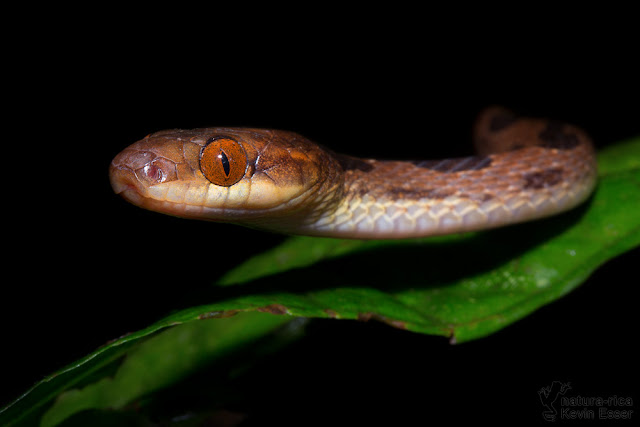
The Northern Cat-eyed Snake (Leptodeira septentrionalis) is very common. It was the first snake we found at night. They mainly feed on frogs and their eggs.

Hourglass Treefrog - Dendropsophus ebraccatus

This handsome Hourglass Treefrog (Dendropsophus ebraccatus) is calling for love...

Hourglass Treefrog - Dendropsophus ebraccatus (in amplexus)

...while this one already found a female for breeding. To me, the Hourglass Treefrog is one of the prettiest frog species in Costa Rica. A nice looking Tropical Orb Weaver (Eriophora fuliginea) built it's web next to the trail. The orange coloration of their underside is amazing, still I wanted to get a glance at it's back. Therfore I had to crawl underneath the web. I am not really afraid of spiders, but doing this (in the dark!) was somehow quite thrilling.

Tropical Orb Weaver - Eriophora fuliginea

Tropical Orb Weaver - Eriophora fuliginea

The Warszewitsch's Frog (Lithobates warszewitschii) is well camouflaged. He fits perfect with the leaf litter.

Warszewitsch's Frog - Lithobates warszewitschii

To show it's beauty and the pointy snout, here is another specimen. The name is kind of hard to pronounce and I assume I mess it up pretty bad, but I really like this frog.

Warszewitsch's Frog - Lithobates warszewitschii

The "Cutie-Award" goes to this juvenile Blunthead Tree Snake (Imantodes cenchoa).

Blunthead Tree Snake - Imantodes cenchoa

Blunthead Tree Snake - Imantodes cenchoa

Last but not least, a beautiful Leaf Litter Toad (Rhaebo haematiticus)

Leaf Litter Toad - Rhaebo haematiticus