Friday, February 16, 2018

New nocturnal neighbors

Since January I am working (volunteering) for Callidryas Tours and Arenal Oasis as a tour guide. At the Arenal Oasis Eco Lodge I saw numerous animals, especially during the night hikes. Here I want to share some of those with you.

Powdered Glass Frog - Teratohyla pulverata

This cute Powdered Glass Frog (Teratohyla pulverata) messures barely a length of 3 cm (1.2 in) max. Due to their small size and good camouflage, they are hard to find.

Blunthead Tree Snake - Imantodes cenchoa

I found this juvenile Blunthead Tree Snake (Imantodes cenchoa) coiled up on the leaf of a bromelia. These snakes feed mainly on frogs and lizards.

Cricket

Shiny green Rhinoceros Katydid (Copiphora cultricornis) nymph.

Pygmy Rain Frog - Pristimantis ridens

The Pygmy Rain Frog (Pristimantis ridens) is very common in this area. Growing to 2.5 cm (0.98 in), this is another very small species.

Striated Webfoot Salamander - Bolitoglossa striatula

Quite rare to see: Striated Webfoot Salamander (Bolitoglossa striatula). This species occurs in Honduras, Nicaragua and Costa Rica. 

Bullet Ant - Paraponera clavata

This big ant is 3 cm (1.2 in) long and feared by man. The sting of this species is considered to be the most painful sting of the entire insect kingdom. It's described to be as painful as a gunshot. That's why this ant is called Bullet Ant (Paraponera clavata).

Red-eyed Treefrog - Agalychnis callidryas

The Red-eyed Treefrog (Agalychnis callidryas) should be part of every night hike in Costa Rica...

Eyelash Viper - Bothriechis schlegelii

Beautiful coloration on this juvenile Eyelash Viper (Bothriechis schlegelii). They are ambush predators, so they can remain motionless for hours.

Emerald Glass Frog - Espadarana prosoblepon

And thus the circle closes, I finish this report as I started it: with a member of the amphibian family called Centrolenidae. This one is an Emerald Glass Frog (Espadarana prosoblepon).


Wednesday, January 31, 2018

Costa Rica - Birds

I've been in Costa Rica since November 13th and have not shown a single picture of a bird yet. That is no longer acceptable... so I want to catch up here.   In this post I show some of the birds that I could photograph so far. Including migratory birds there are more than 900 species in Costa Rica... it's every birder's paradise!

Summer Tanager - Piranga rubra

The Summer Tanager (Piranga rubra) is one of those migratory birds. Living most of the year in the southern part of the USA, coming to visit Central America during the winter. This is a beautiful male. The females are less colorful, more brownish.

Blue-gray Tanager - Thraupis episcopus

The very common Blue-gray Tanager (Thraupis episcopus) doesn't show a significant gender dimorphism.        

Golden-hooded Tanager - Tangara larvata

Definitely one of my favorite birds I've seen so far: Golden-hooded Tanager (Tangara larvata)

Rufous Motmot - Baryphthengus martii

The Rufous Motmot (Baryphthengus martii) is 46 cm (18 in) long and weights 195 g (6.9 oz). This bird feeds on insects, lizards, frogs, fish, crabs, and many fruits.

Red-legged Honeycreeper - Cyanerpes cyaneus ♀

With approximately 12.2 cm (4.8 in) length, the Red-legged Honeycreeper (Cyanerpes cyaneus) is a quite small bird. The green females are very pretty birds...

Red-legged Honeycreeper - Cyanerpes cyaneus ♂

...but the shiny blue males are even prettier. These birds look like flying gems!

Yellow-throated Toucan - Ramphastos ambiguus

And finally the famous one! This is the largest species of toucan, living in Costa Rica: the Yellow-throated Toucan (Ramphastos ambiguus). It reaches a total length of 47–61 cm (19–24 in). It feeds mainly on fruits, but also on lizards, snakes, rodents, smaller birds and insects.


Sunday, January 14, 2018

Oxyrhopus petolarius

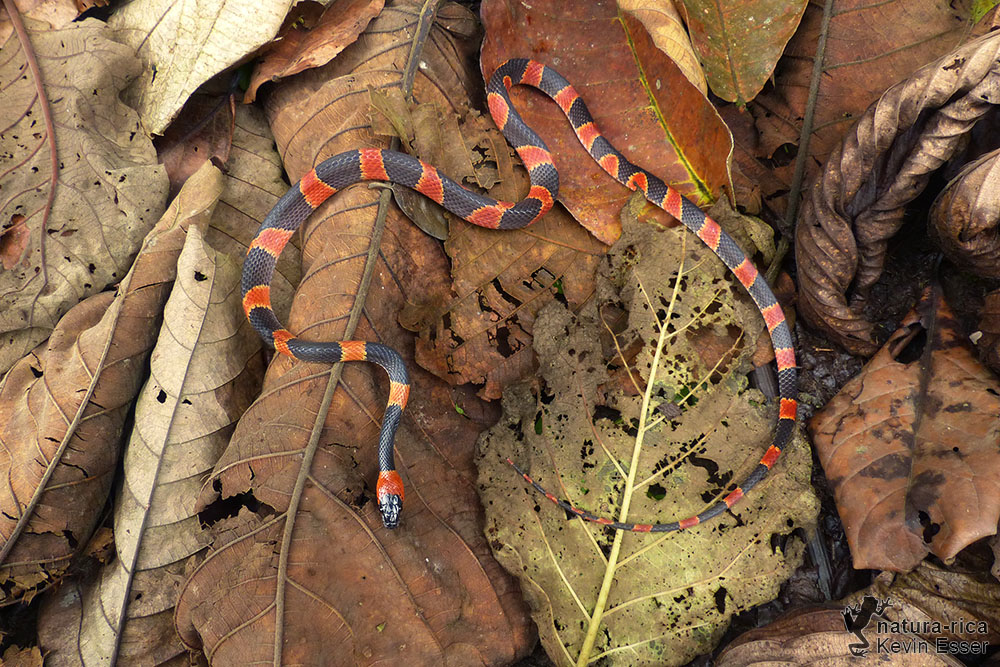
I found this beautiful False Coral Snake or Calico Snake (Oxyrhopus petolarius) in the rainforest close to La Fortuna.

This snake is a mimic of the Many-banded Coralsnake (Micrurus multifasciatus). It is rear-fanged and eats mainly lizards and other snakes. Females are larger than males and can reach a length of 1 m. This species is active day and night.


Oxyrhopus petolarius - False Coral Snake

Oxyrhopus petolarius - False Coral Snake